
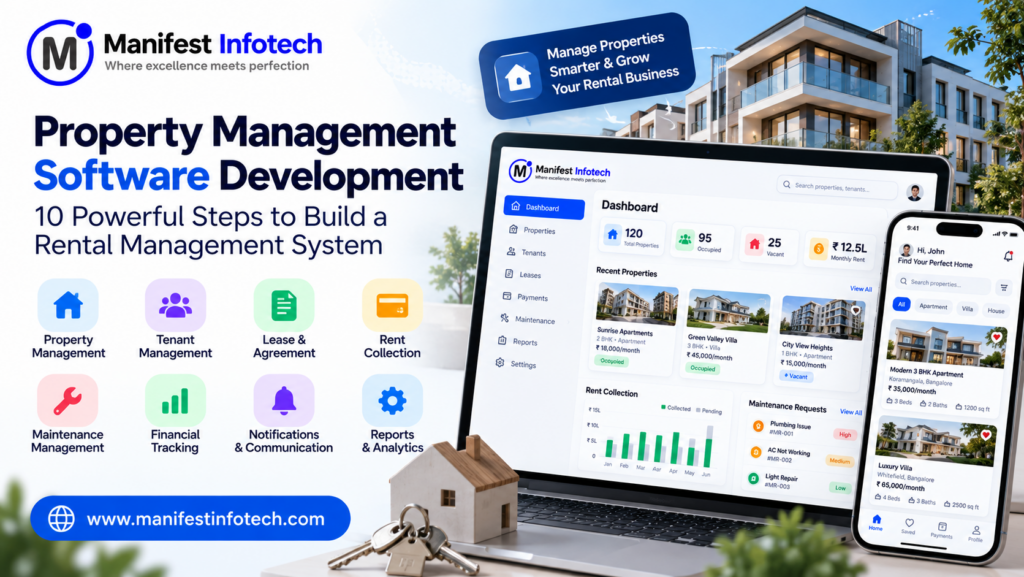
Property Management Software Development: 10 Powerful Steps to Build a Rental Management System
The real estate and rental industry is becoming increasingly digital. Property owners, landlords, and property management companies are managing more properties, tenants, rental payments, maintenance requests, and agreements than ever before.
Managing these activities manually through spreadsheets, phone calls, paperwork, and separate applications can become time-consuming and difficult as a rental business grows.
This is where a Property Management System (PMS) becomes valuable.
A property management system helps rental businesses manage their properties, tenants, leases, rent collection, maintenance activities, and financial records through a centralized digital platform.
For real estate companies, landlords, and property management startups, developing custom rental property management software can improve operational efficiency, simplify communication, and provide better control over property-related activities.
But how do you develop a property management system? What features should it include? Which technologies should you use? How much does development cost?
In this guide, we will explain the complete process of property management software development, including essential features, technology stack, development steps, estimated costs, challenges, and future trends.
What Is a Property Management System?
A Property Management System (PMS) is a software application designed to help property owners and management companies manage residential, commercial, and rental properties.
It centralizes important property-related operations, allowing users to manage properties, tenants, rental agreements, payments, maintenance requests, and financial information from one platform.
A modern property management system can be developed as a web application, mobile application, or cloud-based software solution.
Depending on business requirements, it may support:
- Residential property management.
- Commercial property management.
- Apartment and housing management.
- Rental property management.
- Vacation rental management.
- Real estate portfolio management.
- Multi-property management.
For example, a property management company handling 100 rental apartments can use a centralized system to track available properties, tenant details, monthly rent, lease expiry dates, and maintenance requests without maintaining multiple spreadsheets.
Why Do Rental Businesses Need Property Management Software?
Traditional property management processes often involve manual record keeping, separate communication channels, and repetitive administrative tasks.
As the number of properties and tenants increases, these processes become harder to manage.
Here are some important reasons why rental businesses are adopting property management software.
1. Centralized Property Management
A property management system allows businesses to manage all their properties from one dashboard.
Property owners can view property details, occupancy status, rental prices, tenant information, and availability without switching between different tools.
2. Automated Rent Collection
Tracking monthly rental payments manually can create unnecessary administrative work.
Property management software can automate payment reminders, track outstanding rent, generate payment records, and provide digital receipts.
Depending on the payment provider, businesses can also integrate online payment functionality.
3. Better Tenant Management
A centralized tenant management system stores important tenant information, including contact details, lease documents, payment history, and communication records.
This makes it easier to manage tenant relationships and respond to requests.
4. Efficient Maintenance Management
Maintenance requests can be submitted, assigned, tracked, and resolved through a centralized system.
Property managers can monitor repair activities, assign service providers, and maintain maintenance records.
5. Improved Financial Tracking
Rental businesses need accurate financial records to monitor income and expenses.
Property management software can provide reports covering rent collected, pending payments, maintenance expenses, and property-related costs.
6. Better Business Decisions
Analytics and reporting tools help property owners understand occupancy rates, rental income, overdue payments, and property performance.
These insights can support better decisions about pricing, maintenance, and property investments.
10 Essential Features of a Property Management System
A successful property management system should simplify daily operations for property owners, managers, tenants, and service providers.
Here are 10 essential features to consider when developing rental property management software.
1. Property Listing and Management
Property management begins with maintaining accurate property information.
The system should allow administrators and property owners to add, edit, update, and manage property records.
Important features include:
- Property name and address.
- Property type.
- Number of bedrooms and bathrooms.
- Property photographs and videos.
- Rental price.
- Security deposit.
- Availability status.
- Property amenities.
- Ownership information.
- Property documents.
For businesses managing multiple locations, property categorization and search filters can make property management easier.
2. Tenant Management
Tenant management is one of the most important components of a rental management system.
The platform should provide a centralized database for storing and managing tenant information.
Important features include:
- Tenant registration.
- Contact information.
- Identity verification workflows.
- Rental history.
- Lease information.
- Payment records.
- Document uploads.
- Tenant communication history.
Access to sensitive tenant information should be restricted according to user roles and business permissions.
3. Lease and Agreement Management
Managing rental agreements manually can lead to missed renewal dates and documentation problems.
A property management system should help users create, store, manage, and track rental agreements.
Useful functionalities include:
- Digital lease document storage.
- Lease start and end dates.
- Rental terms.
- Security deposit information.
- Renewal reminders.
- Agreement status.
- E-signature integration.
- Document download.
Digital signing should be integrated through a suitable provider and configured according to applicable legal requirements.
4. Automated Rent Collection and Payment Tracking
Rent collection is a critical activity for rental businesses.
The platform should make it easy to monitor rent payments and identify overdue accounts.
Important functionalities include:
- Monthly rent schedules.
- Online payment integration.
- Automatic payment reminders.
- Payment history.
- Pending payment tracking.
- Digital receipts.
- Late payment records.
- Security deposit tracking.
Payment gateway integration can help tenants pay rent through supported digital payment methods.
5. Maintenance Request Management
Maintenance management helps property managers handle repair requests efficiently.
Tenants should be able to report problems directly through the application.
Important features include:
- Maintenance request submission.
- Image and document uploads.
- Issue categorization.
- Priority assignment.
- Service provider allocation.
- Request status tracking.
- Maintenance history.
- Repair cost tracking.
For example, if a tenant reports a plumbing problem, the property manager can assign a plumber and monitor the repair until completion.
6. Tenant and Owner Portals
A dedicated portal provides different users with access to relevant information.
Tenant Portal:
- View rental agreements.
- Pay monthly rent.
- Download receipts.
- Submit maintenance requests.
- Receive notifications.
- Update permitted profile information.
Property Owner Portal:
- View property performance.
- Monitor rental income.
- Check occupancy.
- Review maintenance expenses.
- Access financial reports.
- View tenant information according to permissions.
Separate portals improve transparency and reduce communication overhead.
7. Financial Management and Reporting
Financial management features help rental businesses understand their income and expenses.
Useful features include:
- Rental income reports.
- Outstanding rent reports.
- Maintenance expense reports.
- Property-wise income tracking.
- Security deposit records.
- Expense categorization.
- Downloadable financial reports.
For businesses with complex accounting requirements, integration with accounting software may also be useful.
8. Notifications and Reminders
A notification system helps property managers and tenants stay informed about important activities.
Examples include:
- Upcoming rent due dates.
- Overdue payment reminders.
- Lease expiry notifications.
- Maintenance request updates.
- Agreement renewal reminders.
- Payment confirmations.
- Important announcements.
Notifications can be delivered through email, SMS, and mobile push notifications.
9. Property Search and Availability Management
Property search functionality is especially useful for rental businesses that manage properties available for new tenants.
Potential features include:
- Search by location.
- Property type filters.
- Rental price filters.
- Availability status.
- Property photographs.
- Property descriptions.
- Viewing appointment requests.
- Inquiry management.
Map-based property search can also improve the experience for prospective tenants.
10. Analytics and Dashboard
An analytics dashboard gives property managers a quick overview of business performance.
Important metrics include:
- Total properties.
- Occupied properties.
- Vacant properties.
- Monthly rental income.
- Pending rent.
- Lease agreements expiring soon.
- Open maintenance requests.
- Property-wise performance.
A well-designed dashboard helps businesses identify operational issues and make informed decisions.
Step-by-Step Process to Develop a Property Management System
Developing reliable rental property management software requires proper planning, technical architecture, development, testing, and deployment.
Here are 10 major steps involved in the process.
Step 1: Identify Business Requirements
Begin by understanding the rental business and the problems the software needs to solve.
Different businesses have different requirements.
For example:
- Individual landlords may need property records and rent tracking.
- Property management companies may need multi-property and tenant management.
- Real estate agencies may need property listings and inquiry management.
- Commercial property managers may need complex lease and expense management.
- Vacation rental businesses may need booking calendars and check-in management.
Identify the target users, expected number of properties, user roles, business workflows, and essential features.
Step 2: Define the Core Modules
After identifying requirements, divide the application into functional modules.
A typical property management system may include:
- User authentication and access management.
- Property management.
- Tenant management.
- Lease management.
- Rent collection.
- Maintenance management.
- Owner and tenant portals.
- Financial reporting.
- Notifications.
- Analytics dashboard.
Defining modules before development helps establish clear project scope and development priorities.
Step 3: Design UI/UX
The application should be easy to use for property managers, landlords, and tenants.
Create separate interfaces based on user roles.
Important design considerations include:
- Simple dashboard layouts.
- Easy property navigation.
- Clear payment information.
- Accessible maintenance request forms.
- Responsive mobile design.
- Search and filtering functionality.
- Easy document access.
Use wireframes and prototypes to validate the user experience before development.
Tools such as Figma can help create and test application designs.
Step 4: Select the Right Technology Stack
The technology stack plays an important role in application performance, security, scalability, and maintenance.
Here is a recommended technology stack for a modern property management system.
| Development Layer | Recommended Technologies |
|---|---|
| Frontend | React.js / Next.js |
| Mobile Application | React Native |
| Backend | Node.js / Express.js |
| Database | PostgreSQL / MongoDB |
| Authentication | JWT / OAuth 2.0 |
| Real-Time Communication | Socket.IO / WebSockets |
| Payment Integration | Stripe / Razorpay |
| Cloud Hosting | AWS / Azure |
| File Storage | AWS S3 |
| Maps and Location | Google Maps Platform |
| Testing | Jest / Playwright |
| Deployment | Docker / CI/CD |
For example, a MERN stack (MongoDB, Express.js, React.js, and Node.js) can be a suitable option for building a custom property management application.
PostgreSQL is also a strong choice when the application requires structured relationships and financial transactions.
The final selection should depend on the business requirements and expected scale.
Step 5: Develop the Backend and Database
The backend manages the application’s business logic, user permissions, data processing, and communication with the database.
Important database entities may include:
- Users.
- Roles and permissions.
- Properties.
- Property units.
- Tenants.
- Owners.
- Lease agreements.
- Rent invoices.
- Payments.
- Security deposits.
- Maintenance requests.
- Service providers.
- Notifications.
- Audit logs.
The database should maintain reliable relationships between properties, tenants, agreements, invoices, and payment records.
Financial operations should use appropriate transaction handling to prevent duplicate or inconsistent payment records.
Step 6: Develop the Frontend Application
The frontend provides the interface through which users interact with the system.
Develop separate dashboards for:
Administrators: Manage users, properties, permissions, and application settings.
Property Managers: Manage tenants, agreements, rental payments, and maintenance requests.
Property Owners: Monitor rental income, occupancy, and property performance.
Tenants: View agreements, pay rent, download receipts, and submit maintenance requests.
A responsive interface ensures that users can access important functionality from desktops, tablets, and mobile devices.
Step 7: Integrate Payment Gateways
Payment integration is essential for businesses that want to collect rental payments digitally.
A suitable payment gateway can support:
- Online rent payments.
- Payment confirmation.
- Digital receipts.
- Refund processing.
- Payment history.
- Webhook-based transaction updates.
For Indian rental businesses, Razorpay may be considered. For international operations, providers such as Stripe may be suitable depending on supported countries and business eligibility.
Never store sensitive card details directly in the application database. Use secure payment provider integrations and verify payment notifications on the server.
Step 8: Implement Security and Access Control
Property management applications store sensitive information, including tenant details, financial records, rental agreements, and identity documents.
Security must be included from the beginning.
Important security practices include:
- HTTPS encryption.
- Secure password hashing.
- Role-based access control.
- Multi-factor authentication where appropriate.
- Secure session management.
- API authentication.
- Input validation.
- Protection against common web vulnerabilities.
- Encrypted storage for sensitive information.
- Regular backups.
- Audit logging.
If the platform serves multiple property management companies, implement tenant isolation at the data-access layer so one organization cannot access another organization’s records.
Step 9: Perform Testing and Quality Assurance
Before deployment, test all major application features.
Important testing types include:
Functional Testing: Verify property creation, tenant registration, lease management, rent tracking, and maintenance workflows.
Integration Testing: Check communication between frontend, backend, databases, and payment providers.
Security Testing: Identify unauthorized access, data exposure, and application vulnerabilities.
Performance Testing: Evaluate application performance when multiple users access the platform simultaneously.
Compatibility Testing: Test across different browsers, devices, and screen sizes.
User Acceptance Testing: Allow actual property managers and tenants to test the system before launch.
Special attention should be given to payment accuracy, access permissions, lease renewal reminders, and data consistency.
Step 10: Deploy and Maintain the Application
After successful testing, deploy the application to reliable cloud infrastructure.
Important deployment requirements include:
- Production server configuration.
- Domain and SSL certificate.
- Database setup.
- File storage.
- Application monitoring.
- Error logging.
- Automated backups.
- CI/CD pipelines.
- Security monitoring.
After launch, continuously monitor performance, fix bugs, update dependencies, and introduce new features based on customer feedback.
How Much Does It Cost to Develop a Property Management System?
The cost of property management software development depends on application complexity, features, user roles, integrations, UI/UX requirements, and infrastructure.
Below are illustrative development cost estimates for the Indian market.
| Software Type | Estimated Development Cost |
|---|---|
| Basic Rental Management System | ₹2 lakh – ₹5 lakh |
| Mid-Level Property Management Software | ₹5 lakh – ₹12 lakh |
| Advanced Property Management Platform | ₹12 lakh – ₹25 lakh |
| Enterprise Property Management System | ₹25 lakh – ₹50 lakh+ |
These are indicative planning estimates, not fixed market quotations. Actual costs depend on project scope, integrations, infrastructure, and development requirements.
Factors That Affect Development Costs
1. Feature Complexity: Advanced lease management, payment automation, analytics, and maintenance workflows increase development effort.
2. Application Type: A web-only application may have a different budget from a solution requiring separate or cross-platform mobile applications.
3. UI/UX Design: Custom dashboards and user-specific portals influence design and development costs.
4. Third-Party Integrations: Payment gateways, mapping services, accounting tools, and notification providers may involve additional setup and recurring fees.
5. Security Requirements: Applications handling financial information and personal documents require appropriate security controls.
6. Scalability: Managing thousands of properties and users requires careful infrastructure and performance planning.
7. Maintenance: Hosting, technical support, upgrades, and monitoring contribute to ongoing expenses.
For startups and small rental businesses, starting with an MVP can help control initial investment.
Challenges in Developing Property Management Software
Building a property management system involves several technical and operational challenges.
1. Managing Multiple Properties and Tenants
As rental businesses grow, managing property records and tenant information becomes more complex.
Solution: Implement structured database relationships, property categorization, search filters, and role-based dashboards.
2. Payment Tracking and Accuracy
Payment processing errors or duplicate transactions can create financial discrepancies.
Solution: Use trusted payment gateways, server-side payment verification, transaction records, and proper webhook handling.
3. Protecting Sensitive Tenant Information
Rental applications may store identity documents, agreements, contact details, and financial records.
Solution: Use encryption, secure access permissions, audit logs, and appropriate data retention policies.
4. Handling Lease Expiry and Renewals
Missing lease expiry dates can create operational and legal complications.
Solution: Implement automated reminders, configurable notification schedules, and agreement status tracking.
5. Managing Maintenance Requests
Unorganized repair requests can result in delays and poor tenant experiences.
Solution: Use maintenance workflows with priority levels, service provider assignment, deadlines, and status updates.
6. Supporting Business Growth
A system that works for 10 properties may not perform efficiently when the business manages thousands.
Solution: Build scalable architecture, optimize database queries, use caching, and monitor application performance.
Future Trends in Property Management Software Development
The real estate technology industry is evolving with automation, artificial intelligence, and connected digital services.
Here are some important trends shaping the future of property management software.
Artificial Intelligence in Property Management
AI can assist property managers with tenant communication, document classification, maintenance request categorization, and business insights.
AI-powered chatbots can answer common tenant questions and help route requests to the appropriate department.
Automated Rental Management
Automation can simplify recurring activities such as rent reminders, lease expiry notifications, invoice generation, and maintenance updates.
Smart Property and IoT Integration
Smart locks, connected sensors, security systems, and energy monitoring devices can be integrated into property management platforms.
These integrations may help improve security, energy management, and operational visibility.
Predictive Maintenance
Data from maintenance records and connected devices can help identify recurring problems and prioritize inspections.
Predictive maintenance can help property managers address certain issues before they become more expensive repairs.
Cloud-Based Property Management
Cloud-based systems allow property managers and owners to access business information from different locations.
They also provide opportunities for scalable infrastructure, centralized updates, and remote collaboration.
Mobile-First Property Management
Mobile applications can make it easier for landlords, managers, tenants, and maintenance teams to access important services while away from their offices.
Why Choose Manifest Infotech for Property Management Software Development?
Developing a successful property management system requires more than building a website or dashboard. It requires a clear understanding of rental workflows, tenant management, financial operations, security, and business scalability.
Manifest Infotech helps businesses turn software ideas into practical digital solutions through custom software and application development.
Whether you are a real estate startup, rental property management company, individual property owner, or established real estate business, a customized property management platform can help simplify your operations.
A custom solution can be developed around your specific requirements, including:
- Custom property management software development.
- Rental and tenant management systems.
- Property listing and management dashboards.
- Lease and agreement management.
- Automated rent collection.
- Payment gateway integrations.
- Maintenance request management.
- Owner and tenant portals.
- Financial reporting and analytics.
- Web and mobile application development.
- Ongoing maintenance and technical support.
The right software should be designed around your business model, number of properties, user requirements, and future growth plans.
Looking to develop custom property management software for your rental business?
Connect with Manifest Infotech to discuss your requirements and explore the right development approach for your real estate business.
Conclusion
Developing a property management system can help rental businesses modernize their operations, improve tenant communication, simplify rent collection, and manage properties more efficiently.
From property listings and tenant management to lease agreements, payment tracking, maintenance requests, and financial reporting, every feature contributes to a more organized rental management process.
The key to successful property management software development is identifying business requirements, choosing the right technology stack, designing secure architecture, and testing important workflows before launch.
Start with an MVP, understand user feedback, and gradually introduce advanced capabilities such as automation, AI-powered assistance, and smart property integrations.
Ready to build a property management system for your rental business? Contact Manifest Infotech and turn your real estate software idea into a scalable digital solution.
Frequently Asked Questions (FAQs)
1. What is a property management system?
A property management system is software that helps landlords and property management companies manage properties, tenants, rental agreements, payments, maintenance requests, and financial records.
2. How much does it cost to develop a property management system in India?
A basic property management system may cost approximately ₹2 lakh–₹5 lakh. Advanced applications can cost ₹12 lakh–₹25 lakh or more, depending on features, integrations, and complexity.
3. How long does it take to develop rental property management software?
A basic system may take approximately 6–10 weeks, while an advanced property management platform may require 3–6 months or longer.
4. What are the essential features of property management software?
Essential features include property management, tenant management, lease tracking, rent collection, maintenance requests, financial reporting, notifications, and user dashboards.
5. Which technology is best for property management software development?
React.js, Next.js, Node.js, Express.js, PostgreSQL, MongoDB, and cloud platforms such as AWS are popular technology choices. The best stack depends on business requirements and application complexity.
6. Can property management software automate rent collection?
Yes. It can integrate with payment gateways, generate rent reminders, track transactions, update payment statuses, and issue digital receipts.
7. Can tenants use a property management mobile application?
Yes. A tenant mobile application can allow users to view rental agreements, pay rent, download receipts, submit maintenance requests, and receive important notifications.
8. Is custom property management software better than ready-made software?
Custom software is useful when a business has specific workflows, integrations, reporting needs, or branding requirements that existing solutions cannot adequately support. Ready-made software may be more suitable for businesses with standard requirements and limited budgets.
9. Can property management software support multiple properties?
Yes. A properly designed system can manage multiple properties, units, tenants, owners, and rental agreements through a centralized dashboard.
10. Can AI be integrated into property management software?
Yes. AI can support tenant communication, maintenance request classification, document processing, property analytics, and other automation workflows.
11. Can property management software integrate with accounting applications?
Yes. Custom integrations can synchronize relevant financial records with supported accounting applications, depending on available APIs and business requirements.
12. Why should a rental business invest in custom property management software?
Custom software can help rental businesses centralize operations, reduce manual administrative work, improve payment tracking, organize maintenance activities, and build workflows that match their specific business needs.