
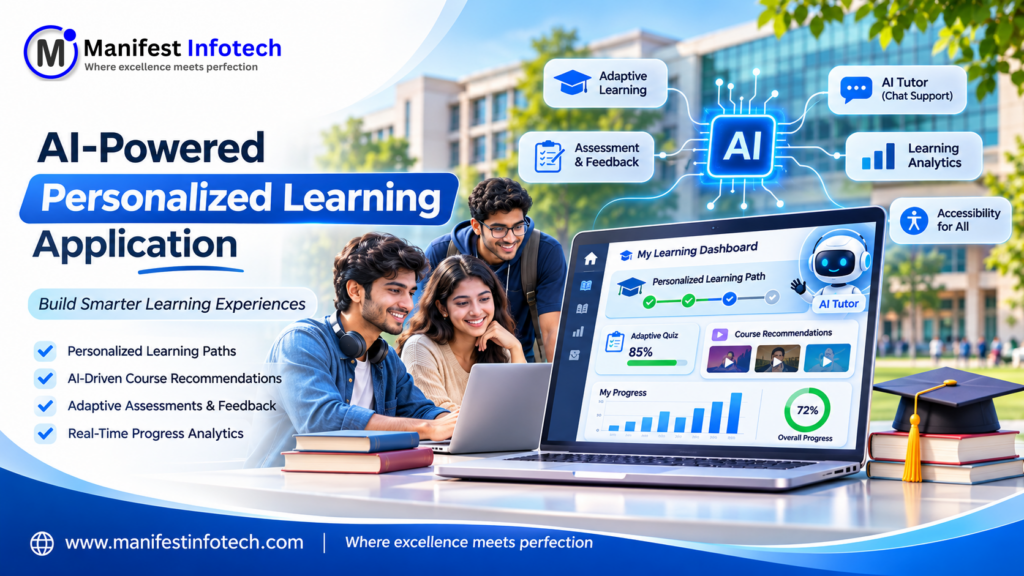
Introduction
Traditional learning platforms often provide the same lessons, exercises, and assessments to every student, regardless of their knowledge level, learning speed, or individual requirements. However, every learner is different. Some students understand concepts quickly, while others need additional explanations, practice questions, and personalized guidance.
This is where an AI-powered personalized learning application can transform the educational experience.
By combining artificial intelligence, machine learning, learning analytics, and adaptive content delivery, modern educational applications can create customized learning experiences for individual students. These applications can analyze learning activities, identify knowledge gaps, recommend relevant resources, and adjust learning paths based on student progress.
For schools, colleges, coaching institutes, EdTech startups, and online learning businesses, developing an AI-powered personalized learning application offers an opportunity to deliver more engaging and flexible digital education.
In this guide, we will explore how to plan, design, and develop an AI-powered learning platform, including its essential features, recommended technologies, development architecture, implementation process, costs, and best practices.
1. What Is an AI-Powered Personalized Learning Application?
An AI-powered personalized learning application is an educational software platform that uses artificial intelligence to adapt learning content, recommendations, assessments, and educational support according to individual student requirements.
Instead of following one fixed learning path, students receive learning recommendations based on their performance, interests, previous activities, and understanding of different subjects.
For example:
- A student struggling with mathematics receives additional practice questions.
- A student performing well in science receives more advanced learning materials.
- A learner preparing for an examination receives a customized revision plan.
- A student who repeatedly makes mistakes receives explanations and related exercises.
- A learner interested in programming receives relevant courses and projects.
How AI Personalizes Learning
The application collects relevant learning activity data, processes it through recommendation and prediction systems, and uses the results to improve the student’s learning experience.
A typical workflow looks like this:
- Student creates an account.
- Student completes an initial assessment.
- Application evaluates the student’s knowledge level.
- AI identifies strengths and knowledge gaps.
- Personalized learning content is recommended.
- Student completes lessons and assessments.
- The system evaluates performance.
- Learning recommendations are updated.
The objective is to make education more adaptive, engaging, and responsive to individual learning needs.
2. Why Build an AI-Powered Personalized Learning Application?
The demand for flexible digital education has created opportunities for educational institutions and EdTech businesses to develop intelligent learning platforms.
An AI-powered personalized learning application can provide several benefits.
Personalized Learning Experience
Students can receive lessons, practice exercises, and recommendations according to their individual progress rather than following an identical learning sequence.
Better Student Engagement
Interactive lessons, AI-based recommendations, progress tracking, and personalized learning goals can help make digital education more engaging.
Early Identification of Knowledge Gaps
Learning analytics can identify topics where students repeatedly struggle, helping teachers provide additional support.
Automated Educational Assistance
AI tutors can answer questions, explain concepts, generate practice exercises, and provide learning guidance.
Improved Teacher Productivity
Teachers can use performance dashboards and automated reports to understand student progress and identify learners who may need attention.
Scalable Education Delivery
Educational organizations can support larger groups of learners while maintaining personalized learning workflows, provided the underlying infrastructure and content operations are designed appropriately.
3. Essential Features of an AI-Powered Learning Application
Feature planning is one of the most important stages of educational software development.
A successful AI-powered personalized learning application should combine student-facing features, intelligent recommendation systems, teacher tools, and administrative controls.
1. Student Registration and Personalized Profiles
Every student should have an individual profile containing relevant learning information.
Important profile details include:
- Name and academic information.
- Learning interests.
- Preferred learning format.
- Selected courses.
- Previous assessment results.
- Learning goals.
- Current progress.
Students should be able to control their profile information and understand how their learning data is used.
2. AI-Based Learning Recommendations
The recommendation engine suggests lessons, courses, videos, and exercises based on student activity.
For example, if a student repeatedly struggles with algebra, the application can recommend introductory lessons and additional exercises before moving to advanced topics.
Recommendations should consider curriculum requirements and teacher-defined learning objectives, not only past clicks or engagement.
3. Adaptive Assessments and Intelligent Quizzes
Assessments can dynamically adjust their difficulty based on student performance.
For example:
- Correct answers may lead to more challenging questions.
- Incorrect answers may trigger additional practice.
- Repeated mistakes may lead to concept explanations.
- Assessment results may update the learner’s recommended study path.
The system should also provide teachers with control over assessment difficulty, question banks, and evaluation rules.
4. AI-Powered Virtual Tutor
An AI tutor can provide conversational educational assistance.
Students may ask questions such as:
- Explain photosynthesis in simple language.
- Help me understand quadratic equations.
- Give me five practice questions on Python loops.
- Explain why my answer is incorrect.
- Summarize this lesson.
The AI tutor should use approved educational content and provide explanations appropriate to the student’s level.
For important academic topics, answers should include references to trusted course materials where possible.
5. Personalized Learning Paths
The application should generate a structured learning journey for each student.
A learning path may include:
- Recommended lessons.
- Learning objectives.
- Video tutorials.
- Reading materials.
- Practice exercises.
- Assessments.
- Revision activities.
Learning paths should remain editable so teachers can override recommendations when academic requirements demand it.
6. Student Progress and Performance Analytics
Students and teachers should have access to meaningful performance information.
Useful metrics include:
- Course completion percentage.
- Assessment scores.
- Time spent learning.
- Topic-wise performance.
- Strengths and weaknesses.
- Learning milestones.
- Improvement over time.
The analytics should explain what the measurements mean instead of presenting scores without context.
7. AI-Generated Study Plans
An AI-powered study planner can help students organize their learning activities.
For example, a student preparing for an examination in 30 days may receive a study schedule based on available time, syllabus coverage, and assessment performance.
Students should be able to modify their schedules and account for missed study sessions.
8. Gamification and Rewards
Gamification can encourage consistent learning through:
- Achievement badges.
- Learning streaks.
- Points.
- Progress milestones.
- Subject challenges.
- Leaderboards, where appropriate.
Rewards should encourage meaningful learning rather than simply maximizing screen time.
9. Teacher and Instructor Dashboard
Teachers need tools to manage students and monitor educational performance.
Important features include:
- Student management.
- Course management.
- Assignment creation.
- Assessment management.
- Performance reports.
- Learning recommendations.
- At-risk learner identification.
- Manual feedback and intervention.
10. Admin Panel and Content Management
The administrative dashboard should allow authorized users to manage the entire learning platform.
Key capabilities include:
- User and role management.
- Course and subject management.
- Lesson and content management.
- AI configuration.
- Question bank management.
- Subscription management.
- Analytics and reporting.
- Platform settings.
- Content approval workflows.
4. How AI and Machine Learning Work in Personalized Learning
Artificial intelligence is the core technology behind intelligent learning recommendations and adaptive educational experiences.
An AI-powered personalized learning application can combine several AI techniques to understand learning behavior and recommend suitable educational content.
Machine Learning
Machine learning models analyze historical learning activity and assessment results to identify patterns.
Possible applications include:
- Predicting learning difficulties.
- Identifying weak subject areas.
- Recommending learning resources.
- Estimating assessment performance.
- Identifying students who may need additional support.
Predictions should be treated as indicators for review, not definitive judgments about a student’s ability.
Natural Language Processing (NLP)
NLP enables applications to understand and process human language.
It can support:
- AI chat tutors.
- Question answering.
- Text summarization.
- Language learning.
- Automated feedback.
- Educational content search.
Generative AI
Generative AI can help create explanations, practice questions, summaries, and study materials.
For example, a student can request a simple explanation of a difficult programming concept, and the AI tutor can generate an explanation appropriate to the learner’s level.
Generated educational content should be checked for accuracy, curriculum alignment, bias, and inappropriate material.
Recommendation Systems
Recommendation systems select learning materials based on student interests, performance, learning objectives, and previous activities.
A hybrid recommendation approach can combine:
- Content-based recommendations.
- Collaborative filtering, where suitable data is available.
- Rule-based academic recommendations.
- Teacher-defined curriculum requirements.
This helps create recommendations that are both personalized and educationally relevant.
5. Recommended Technology Stack
Choosing the right technology stack is essential for building a scalable AI-powered personalized learning application.
The technology should support interactive interfaces, secure APIs, AI integrations, data processing, and reliable content delivery.
| Application Layer | Recommended Technology |
|---|---|
| Frontend | React.js, Next.js |
| Mobile Application | React Native, Flutter |
| Backend | Node.js, Express.js, Python, FastAPI |
| Database | PostgreSQL |
| AI and Machine Learning | Python, PyTorch, Scikit-learn |
| AI Integration | LLM APIs, embedding models |
| Vector Search | pgvector or dedicated vector database |
| File Storage | AWS S3 |
| Authentication | OAuth 2.0, secure session management |
| Deployment | AWS, Docker, CI/CD |
| Analytics | Custom dashboards, event analytics |
Why Choose Next.js and React?
Next.js and React are suitable for building modern learning dashboards, course interfaces, administrative panels, and interactive student experiences.
Next.js supports server-rendered and statically generated pages, while React supports interactive application components.
Why Choose Node.js and Python?
Node.js can manage application APIs, authentication, course workflows, and real-time interactions.
Python is particularly useful for machine learning pipelines, data processing, model evaluation, and AI services.
These technologies can work together through secure APIs.
Why Choose PostgreSQL?
PostgreSQL is suitable for structured educational information such as:
- Students.
- Teachers.
- Courses.
- Lessons.
- Assessments.
- Question banks.
- Learning progress.
- Subscription records.
A vector extension such as pgvector can also support semantic search and retrieval-based AI features.
6. Step-by-Step Development Process
Developing an AI-powered personalized learning application requires careful planning and a phased implementation approach.
Step 1: Define the Learning Objectives
Before development begins, identify the educational problems the application should solve.
Determine:
- Target student age groups.
- Educational subjects.
- Learning objectives.
- Types of courses.
- Assessment requirements.
- Teacher involvement.
- Expected number of users.
Start with a specific learning use case rather than attempting to build every AI feature immediately.
Step 2: Conduct UI/UX Research
Design interfaces for different user roles.
The main interfaces should include:
- Student dashboard.
- Teacher dashboard.
- Admin dashboard.
- Course interface.
- Assessment interface.
- AI tutor interface.
- Learning analytics dashboard.
Prioritize mobile usability, accessibility, and simple navigation.
Step 3: Design the Database Architecture
Create a database structure that supports users, educational content, assessments, and learning activity records.
Example:
Users
 ├── Students
 ├── Teachers
 └── Administrators

Courses
 ├── Subjects
 ├── Modules
 └── Lessons

Assessments
 ├── Questions
 ├── Student Answers
 └── Results

Learning Analytics
 ├── Activity Records
 ├── Progress Records
 └── Recommendations

AI Services
 ├── AI Tutor Sessions
 ├── Content Embeddings
 └── Recommendation Results
Store sensitive student information separately where appropriate and apply strict access controls.
Step 4: Develop the Core Learning Platform
Build the essential application before introducing complex AI functionality.
Start with:
- Registration and login.
- Student profiles.
- Course management.
- Lesson delivery.
- Assessments.
- Progress tracking.
- Teacher dashboard.
- Administrative dashboard.
This creates a stable educational platform for subsequent AI integrations.
Step 5: Integrate AI Services
Introduce AI capabilities through separate backend services.
For example:
- AI tutor service.
- Content recommendation service.
- Adaptive assessment service.
- Study planner service.
- Learning analytics service.
Keeping these services modular makes it easier to test, replace, and improve individual AI components.
Step 6: Implement Personalized Recommendations
Collect relevant learning activity and assessment information.
Use a recommendation engine to select suitable educational resources.
Start with transparent rules and curriculum-based recommendations. Introduce machine learning models when sufficient quality data is available.
Step 7: Test and Evaluate AI Results
Test AI functionality using realistic educational scenarios.
Evaluate:
- Answer accuracy.
- Recommendation relevance.
- Assessment quality.
- Response latency.
- Hallucination rates.
- Bias and fairness.
- Data security.
- Student and teacher feedback.
Step 8: Deploy and Monitor the Application
Deploy the platform using reliable cloud infrastructure.
Monitor:
- Application availability.
- API response times.
- AI usage and cost.
- Database performance.
- Error rates.
- Learning engagement.
- User feedback.
Continue improving the application based on actual usage and educational outcomes.
7. Example AI Recommendation Architecture
A practical architecture separates the user interface, application backend, educational database, and AI services.
       STUDENT / TEACHER
              |
              v
       Next.js / React
              |
              v
       Node.js Backend
              |
       +------+------+
       |             |
       v             v
  PostgreSQL      Python AI API
       |             |
       |       +-----+------+
       |       |     |      |
       |       v     v      v
       |    AI Tutor  ML   Recommendation
       |             Models Engine
       |                |
       +----------------+
              |
              v
     Personalized Learning
         Recommendations
Example: Simple Recommendation Logic
The following example illustrates a basic rule-based recommendation approach. A production recommendation system would require additional curriculum, assessment, and student-context validation.
function recommendLearningContent(student) {
  if (student.mathScore < 40) {
    return {
      topic: "Mathematics Fundamentals",
      difficulty: "Beginner",
      action: "Practice basic concepts"
    };
  }

  if (student.mathScore < 75) {
    return {
      topic: "Intermediate Mathematics",
      difficulty: "Intermediate",
      action: "Complete practice exercises"
    };
  }

  return {
    topic: "Advanced Mathematics",
    difficulty: "Advanced",
    action: "Explore advanced concepts"
  };
}
This is a simple rules-based example, not a machine learning model. It demonstrates how student performance can influence content recommendations.
8. Data Privacy, Security, and Responsible AI
An AI-powered personalized learning application may process sensitive educational information, including student profiles, assessment records, learning behavior, and communication history.
Security and responsible AI practices must be included from the beginning.
Essential Security Measures
- Encrypt data during transmission and storage.
- Implement role-based access control.
- Secure authentication and session management.
- Validate and sanitize API inputs.
- Apply API rate limiting.
- Maintain audit logs.
- Back up important educational data.
- Restrict access to AI service credentials.
- Review third-party integrations.
- Establish data retention and deletion policies.
Protect Student Privacy
Collect only the information required to deliver the educational service.
For applications involving children, consider age-appropriate design, parental or guardian involvement where required, and applicable child-data protection obligations.
Maintain Human Oversight
AI should support teachers rather than replace their academic judgment.
Teachers should be able to review recommendations, correct inaccurate information, and intervene when students need additional assistance.
AI-generated assessments and educational explanations should be validated before being used in important academic decisions.
9. Common Challenges in AI Learning Application Development
| Challenge | Recommended Solution |
|---|---|
| Limited training data | Start with rule-based recommendations |
| Incorrect AI answers | Use approved learning resources and evaluation |
| High AI API costs | Apply caching, usage limits, and smaller models |
| Poor recommendations | Combine performance data and curriculum rules |
| Student privacy risks | Implement privacy-by-design |
| Slow AI responses | Use asynchronous processing and monitoring |
| Difficult integrations | Use documented APIs and interoperability standards |
| Model bias | Evaluate results across learner groups |
Another challenge is measuring actual learning improvement. High engagement or more completed lessons does not automatically mean better educational outcomes.
Measure knowledge retention, assessment improvement, learning objectives, and teacher feedback.
10. Cost and Time Required to Develop an AI-Powered Learning Application
The development cost depends on the platform’s complexity, number of features, AI model selection, integrations, and expected user volume.
Major Development Cost Factors
| Component | Cost Considerations |
|---|---|
| UI/UX Design | Student, teacher, and admin interfaces |
| Frontend Development | Web and mobile applications |
| Backend Development | APIs, authentication, and business logic |
| AI Integration | AI tutor and recommendation services |
| Machine Learning | Model development and evaluation |
| Database | Storage, analytics, and optimization |
| Cloud Infrastructure | Hosting, storage, and processing |
| Testing | Functional, performance, and AI evaluation |
| Maintenance | Monitoring, updates, and model improvements |
Suggested Development Phases
| Phase | Estimated Duration |
|---|---|
| Research and Planning | 1–2 weeks |
| UI/UX Design | 2–3 weeks |
| Core Platform Development | 4–6 weeks |
| AI Integration | 3–5 weeks |
| Testing and Optimization | 2–3 weeks |
| Deployment | 1 week |
These are indicative planning estimates for a moderate-scope project. Some activities can overlap, while complex mobile applications, custom model training, and enterprise integrations may require additional time.
Start with an MVP
A minimum viable product can include:
- Student and teacher accounts.
- Course and lesson management.
- Online assessments.
- Basic performance analytics.
- Rule-based recommendations.
- An AI-powered learning assistant.
After validating the platform with real learners and educators, introduce advanced machine learning and predictive features.
11. How Manifest Infotech Can Help Develop Your AI Learning Platform
Building an intelligent learning platform requires expertise in frontend development, backend architecture, database engineering, AI integration, and educational application workflows.
Manifest Infotech provides custom web and software development services for businesses, startups, and educational organizations.
Our development capabilities can support the creation of an AI-powered personalized learning application tailored to your educational business requirements.
Our Relevant Development Services
Custom EdTech Application Development
Develop learning platforms with customized student experiences, courses, assessments, and progress tracking.
AI Integration and Development
Integrate AI tutors, intelligent content recommendations, automated assistance, and learning analytics.
LMS Development
Build learning management systems with course delivery, student management, assessments, and instructor dashboards.
Next.js and React Development
Develop responsive, interactive, and scalable learning interfaces.
Node.js and Python Backend Development
Build secure APIs, AI service integrations, recommendation workflows, and application infrastructure.
Admin Dashboard and CMS Development
Manage educational content, students, teachers, courses, AI configurations, and reports through centralized administrative tools.
Mobile Application Development
Develop learning applications for Android and iOS using suitable cross-platform technologies.
Why Choose Manifest Infotech?
- Custom software development solutions.
- Modern frontend and backend technologies.
- Scalable application architecture.
- AI and third-party API integrations.
- Educational platform development.
- Ongoing technical support and maintenance.
Whether you are launching a new EdTech startup, modernizing an existing LMS, or developing an intelligent educational platform, Manifest Infotech can help transform your requirements into a scalable software solution.
Visit https://manifestinfotech.com/ to explore our development services and discuss your project.
Conclusion
Artificial intelligence is creating new opportunities for delivering more flexible, adaptive, and personalized educational experiences.
An AI-powered personalized learning application can help students receive relevant learning recommendations, understand difficult concepts, practice at their own pace, and monitor their academic progress.
However, successful development requires more than integrating an AI model. It involves thoughtful learning design, reliable educational content, secure data architecture, effective recommendation systems, and continuous evaluation.
The best approach is to begin with a strong learning management foundation, introduce practical AI capabilities, and expand the platform as real educational requirements become clear.
If you are planning to develop an intelligent learning platform, Manifest Infotech can help you design and build a solution aligned with your business goals.
Build smarter learning experiences with Manifest Infotech.
Website: https://manifestinfotech.com/
Frequently Asked Questions (FAQs)
1. What is an AI-powered personalized learning application?
It is an educational software platform that uses artificial intelligence to customize lessons, recommendations, assessments, and learning support according to individual student performance and learning requirements.
2. How does AI personalize the learning experience?
AI analyzes relevant student activities, assessment results, learning preferences, and progress to recommend appropriate educational content and learning activities.
3. What are the most important features of an AI learning application?
Important features include personalized learning paths, AI tutors, adaptive assessments, course recommendations, student analytics, study planners, teacher dashboards, and administrative controls.
4. Which technologies are used to develop AI-powered learning applications?
Common technologies include React.js, Next.js, Node.js, Python, FastAPI, PostgreSQL, PyTorch, machine learning libraries, and AI model APIs.
5. Can AI generate questions and assessments automatically?
Yes. Generative AI can help create practice questions, explanations, and assessment drafts. However, generated questions should be reviewed for accuracy, difficulty, curriculum alignment, and suitability before publication.
6. Can an AI learning application support multiple subjects?
Yes. A platform can support multiple subjects and courses by organizing content, learning objectives, assessments, and recommendation rules for each subject.
7. How can an AI tutor help students?
An AI tutor can explain difficult concepts, answer questions, summarize educational material, provide examples, and recommend additional practice based on student needs.
8. How much does it cost to develop an AI-powered learning application?
The cost depends on features, AI integrations, application complexity, infrastructure, and development requirements. An MVP is generally less expensive than an enterprise-grade platform with custom machine learning models and multiple integrations.
9. Is student data secure in AI-powered learning applications?
Student data can be protected through encryption, secure authentication, access controls, privacy-focused data collection, retention policies, and careful management of third-party AI integrations.
10. How long does it take to develop an AI learning application?
A moderate-scope MVP may take approximately 3–5 months, depending on feature complexity, team size, integrations, testing, and deployment requirements.
Official External References
1. UNESCO – Guidance for Generative AI in Education and Research
https://www.unesco.org/en/articles/guidance-generative-ai-education-and-research
Guidance on responsible, human-centred AI in education. UNESCO
2. UNESCO – AI Competency Framework for Students
https://www.unesco.org/en/articles/ai-competency-framework-students
AI literacy, ethics, and responsible AI education. UNESCO
3. 1EdTech – Learning Tools Interoperability (LTI)
https://www.1edtech.org/standards/lti
Standards for integrating educational applications with learning management systems. 1EdTech
4. Next.js – Server and Client Components
https://nextjs.org/docs/app/getting-started/server-and-client-components
Official development documentation. Next.js
5. OWASP – API Security Top 10
https://owasp.org/www-project-api-security/
API security risks and mitigation guidance. OWASP Foundation
6. W3C – WCAG 2.2
https://www.w3.org/TR/WCAG22/
Accessibility guidelines for educational applications. W3C