
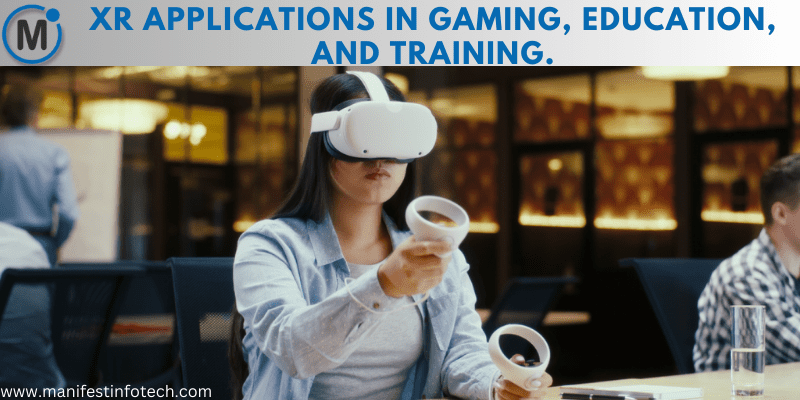
Extended Reality (XR) is rapidly changing the way we interact with digital environments, blending the real and virtual worlds seamlessly. XR, which includes Virtual Reality (VR), Augmented Reality (AR), and Mixed Reality (MR), has revolutionized gaming, education, and training. These technologies enhance engagement, immersion, and experiential learning, making them essential tools in today\’s digital landscape.
XR in Gaming
The gaming industry has been at the forefront of XR innovations, delivering immersive experiences that transport players into hyper-realistic virtual worlds. XR-powered games provide deeper engagement, interactivity, and a sense of presence that traditional gaming cannot achieve.
1. Virtual Reality Gaming
VR headsets such as Oculus Quest, PlayStation VR, and HTC Vive have revolutionized gaming by creating fully immersive environments. Players can explore virtual landscapes, interact with 3D objects, and engage in lifelike combat or puzzle-solving adventures. Games like Half-Life: Alyx and Beat Saber showcase the power of VR in providing a unique and engaging experience.
2. Augmented Reality Gaming
AR games overlay digital content onto the real world, enhancing the gaming experience. Pokémon GO is a prime example, allowing players to hunt virtual creatures in real-world locations. AR also introduces interactive storytelling and multiplayer experiences, expanding the possibilities of mobile gaming.
3. Mixed Reality Gaming
MR blends VR and AR, allowing real-world and virtual elements to interact seamlessly. Devices like Microsoft HoloLens enable users to manipulate digital objects in physical spaces, providing a new dimension to gaming. MR-based escape rooms and interactive multiplayer experiences are gaining popularity, pushing the boundaries of entertainment.
XR in Education
Education has significantly benefited from XR, making learning more interactive, engaging, and effective. Traditional teaching methods are being enhanced with immersive simulations, virtual field trips, and hands-on digital experiences.
1. Virtual Classrooms and Labs
VR enables students to participate in virtual classrooms and conduct complex experiments in simulated labs. Applications like Google Expeditions and Labster allow learners to explore historical sites, dissect virtual organisms, or conduct chemistry experiments in a risk-free environment.
2. Augmented Learning Materials
AR enhances textbooks and learning materials by adding interactive 3D models, animations, and real-time explanations. Apps like AR Flashcards and SkyView help students visualize complex concepts, making learning more engaging and effective.
3. Skill-Based Training
MR provides hands-on learning experiences for various professions. Medical students can practice surgeries using virtual patients, while engineering students can explore 3D prototypes of machines. This interactive learning approach improves retention and practical skills.
XR in Training and Workforce Development
Industries are leveraging XR to enhance employee training, ensuring a more efficient and safe learning process. XR-based training reduces costs, minimizes risks, and improves performance through realistic simulations.
1. Military and Defense Training
VR simulations prepare soldiers for combat scenarios, emergency responses, and tactical strategies. These immersive environments help trainees practice without real-world consequences, improving decision-making skills and readiness.
2. Corporate and Soft Skills Training
Companies use VR to train employees in leadership, communication, and customer service. XR simulations provide real-world scenarios where employees can practice handling conflicts, negotiations, and presentations effectively.
3. Healthcare and Emergency Response
Medical professionals and first responders use XR to practice surgeries, disaster management, and emergency care. Virtual simulations allow healthcare workers to gain hands-on experience without risking patient safety.
Conclusion
XR is reshaping gaming, education, and training, making experiences more immersive, interactive, and effective. As technology advances, XR will continue to enhance various industries, offering innovative solutions for entertainment, learning, and professional development. The future of XR is limitless, promising a world where the boundaries between the real and virtual blur.
If you are looking for any services related to Website Development, App Development, Digital Marketing and SEO, just email us at nchouksey@manifestinfotech.com or Skype id: live:76bad32bff24d30d
𝐅𝐨𝐥𝐥𝐨𝐰 𝐔𝐬:
𝐋𝐢𝐧𝐤𝐞𝐝𝐢𝐧: linkedin.com/company/manifestinfotech
𝐅𝐚𝐜𝐞𝐛𝐨𝐨𝐤: facebook.com/manifestinfotech/
𝐈𝐧𝐬𝐭𝐚𝐠𝐫𝐚𝐦: instagram.com/manifestinfotech/
𝐓𝐰𝐢𝐭𝐭𝐞𝐫: twitter.com/Manifest_info
#XR #Gaming #Education #Training #VirtualReality #AugmentedReality #MixedReality #FutureTech