
Node.js is a powerful runtime environment that enables developers to execute JavaScript on the server side. At the core of its non-blocking, asynchronous architecture lies the Event Loop. Understanding how the Event Loop works is crucial for optimizing Node.js applications and writing efficient code.
What is the Event Loop?
The Event Loop is a mechanism in Node.js that handles asynchronous operations. Unlike traditional multi-threaded architectures, Node.js operates on a single-threaded event-driven model. This means it can manage multiple operations without creating new threads for each request, making it lightweight and efficient.
How Does the Event Loop Work?
The Event Loop continuously checks for tasks, executes them, and waits for new tasks to arrive. It handles operations like I/O, timers, and callbacks by leveraging the underlying libuv library. Library provides a thread pool for operations that require blocking, such as file system or network tasks, while the Event Loop coordinates their execution.
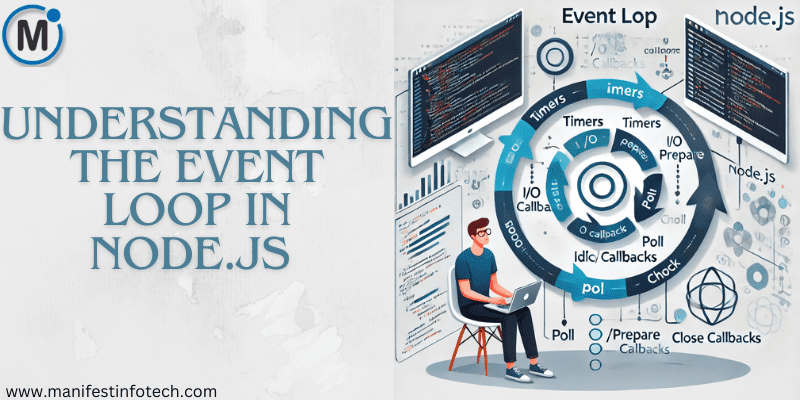
The Event Loop operates in phases, with each phase handling specific types of tasks:
Timers
Executes callbacks scheduled by setTimeout() and setInterval().
These callbacks are run only after the timer’s threshold has been met.
Pending Callbacks
Handles I/O callbacks that were deferred by the system, such as errors or connection closures.
Idle, Prepare
Used internally by Node.js, this phase is not commonly interacted with by developers.
Poll
Retrieves new I/O events and executes callbacks for I/O operations. It waits for new events or continues to the next phase if there are no pending tasks.
Check
Processes callbacks for setImmediate().
Close Callbacks
Executes callbacks for events like close on sockets.
After completing these phases, the Event Loop repeats the cycle.
Key Concepts
1. Non-blocking I/O
Node.js uses non-blocking I/O operations, which means tasks like reading a file or querying a database do not block the main thread. Instead, these operations are delegated to worker threads, and the Event Loop schedules their callbacks once completed.
2. Timers vs Immediate
setTimeout and setInterval execute their callbacks in the Timers phase.
setImmediate executes its callbacks in the Check phase. If both are scheduled without a delay, setImmediate is typically executed first.
3. Blocking the Event Loop
While the Event Loop is efficient, synchronous operations like large loops or complex computations can block it, delaying other tasks. Such blocking operations degrade application performance and responsiveness.
Example of the Event Loop in Action
const fs = require(\’fs\’); console.log(\’Start\’); setTimeout(() => { console.log(\’Timeout\’); }, 0); setImmediate(() => { console.log(\’Immediate\’); }); fs.readFile(__filename, () => { console.log(\’File read\’); }); console.log(\’End\’);
Expected Output:
Start End File read Immediate Timeout
Here:
Start and End are logged synchronously.
fs.readFile schedules its callback in the Poll phase.
setImmediate executes during the Check phase.
setTimeout executes during the Timers phase.
Conclusion
The Event Loop is the backbone of Node.js’s asynchronous, non-blocking architecture. By understanding its phases and behavior, developers can write more efficient and responsive applications. Avoid blocking the Event Loop and leverage its asynchronous nature to build scalable solutions.
If you are looking for any services related to Website Development, App Development, Digital Marketing and SEO, just email us at nchouksey@manifestinfotech.com or Skype id: live:76bad32bff24d30d
𝐅𝐨𝐥𝐥𝐨𝐰 𝐔𝐬:
𝐋𝐢𝐧𝐤𝐞𝐝𝐢𝐧: linkedin.com/company/manifestinfotech
𝐅𝐚𝐜𝐞𝐛𝐨𝐨𝐤: facebook.com/manifestinfotech/
𝐈𝐧𝐬𝐭𝐚𝐠𝐫𝐚𝐦: instagram.com/manifestinfotech/
𝐓𝐰𝐢𝐭𝐭𝐞𝐫: twitter.com/Manifest_info
#Nodejs #EventLoop #JavaScript #AsynchronousProgramming #NonBlockingIO #WebDevelopment #BackendDevelopment #NodejsDevelopment #JavaScriptTips #ProgrammingConcepts #ScalableApplications #TechGuide #CodingTips #WebTechnologies #NodejsTutorial #SoftwareEngineering #WebApps #AsyncProgramming #WebDevTips #DigitalSolutions #ManifestInfotech #WebDevelopmentServices #AppDevelopment #SEO #DigitalMarketing #TechEducation #TechCommunity #TechBlogging